
Hawaii Fishing Season 2026: Year-Round Opportunities Explained
Hawaii’s waterways tell a different tale than those of continental states, where freshwater lakes and trout streams are the main topics of discussion. Here, the ocean reigns supreme—offering year-round possibilities for blue marlin, yellowfin tuna (ahi), mahi mahi, and wahoo (ono). But don’t sleep on the freshwater scene either! Any bass angler’s heart would accelerate when they saw the largemouth bass, channel catfish, and tucunare (peacock bass) that may be found in hidden reservoirs across the islands.
The 2026 rules include some substantial modifications, especially for visiting anglers. As of 2024, non-residents now require a saltwater license to fish Hawaii’s marine waters—a substantial departure from the old “fish anywhere, anytime” days for visitors. Additionally, seasonal closures and species-specific creel limitations are in place to safeguard important reef fish and native species breeding stocks.
This guide includes all the information you need to target trophy billfish off the renowned Kona Coast, cast for ulua from rocky shorelines, or explore bass-filled irrigation reservoirs on Oahu. It includes information on prime catch dates, bag limits, license requirements, and hotspots that consistently yield results. Let’s plunge in!
📅 Quick Reference by Month
Here’s a snapshot of what’s biting throughout the year. Remember, Hawaii fishing is truly year-round—you’ll find something on the line in every season!
| Month | Peak Species | What to Know |
|---|---|---|
| January | Blue Marlin, Ahi (Yellowfin Tuna), Onaga | Cooler water temps; excellent deep-dropping for bottomfish |
| February | Blue Marlin, Ahi, Mahi Mahi (starting) | Mahi mahi begin showing up; winter swells can affect shore access |
| March | Blue Marlin, Mahi Mahi, Striped Marlin | Prime trophy marlin season begins; Amaama (mullet) season CLOSED |
| April | Blue Marlin, Mahi Mahi, Ono (Wahoo) | Excellent all-around month; water warming up |
| May | Blue Marlin, Mahi Mahi, Ono, Ahi | Peak mahi mahi and ono action; transition to summer patterns |
| June | Blue Marlin, Ahi, Ono | Moi season CLOSED; summer blue marlin peak begins |
| July | Blue Marlin, Ahi, Ono | Hot summer action; Moi CLOSED; smaller akule protected |
| August | Blue Marlin, Ahi, Ono | Last month of moi closure; Moi CLOSED |
| September | Blue Marlin, Mahi Mahi, Ahi, Ono | Mahi mahi return; excellent all-species month |
| October | Mahi Mahi, Ahi, Ono, Striped Marlin | Fall transition; great mahi mahi action |
| November | Mahi Mahi, Ahi, Opakapaka, Onaga | Bottomfish season heats up; mahi still excellent |
| December | Ahi, Bottomfish (Deep 7), Blue Marlin | Amaama (mullet) season CLOSED; winter deep-dropping prime |
🐟 Popular Sport Fish
🦈 Blue Marlin (A’u) — The Holy Grail
Peak Season: March-October (with June-August being absolute prime time)
Size/Bag Limits: No minimum size or bag limits for recreational anglers
Where to Target: Kona Coast (Big Island), South Shore of Oahu, Penguin Banks (Molokai)
Blue marlin are the crown jewels of Hawaiian waters. These behemoths can exceed 1,000 pounds, and Kona is world-famous for producing granders. Spring through early fall offers the best shots, though honestly, marlin are caught year-round. The Kona Coast remains the undisputed champion, with its deep drop-offs just minutes from shore creating perfect ambush zones.
🐠 Mahi Mahi (Dorado) — The Acrobatic Fighter
Peak Season: March-May and September-November
Size/Bag Limits: No state restrictions
Where to Target: Open ocean, weedlines, floating debris, fish aggregation devices (FADs)
If you want non-stop action and table fare that’ll make you weep with joy, mahi mahi is your fish. These electric-blue beauties love floating debris and weedlines. Spring and fall bring massive schools, but you’ll find bulls and cows year-round if you know where to look. They’re especially abundant around FADs (fish aggregation devices) that Hawaii deploys to concentrate pelagic species.
🎣 Yellowfin Tuna (Ahi) — The Speedster
Peak Season: May-September
Size/Bag Limits: Minimum 3 pounds for commercial sale only
Where to Target: Deep waters, seamounts, offshore banks
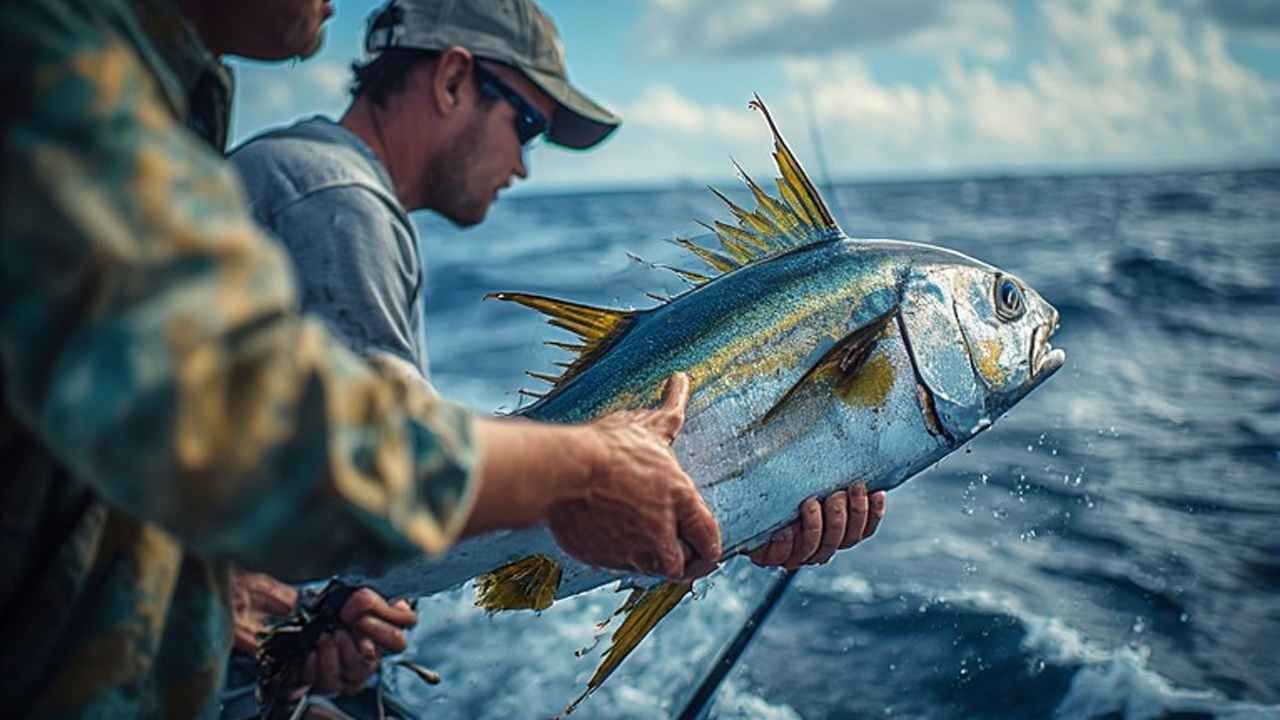
Ahi are the workhorses of Hawaii’s offshore fishery. These torpedo-shaped tuna can reach 200+ pounds and provide sashimi-grade meat that’s simply unmatched. Summer months bring the best action, but winter still produces quality fish. Target depths of 60-100 fathoms around underwater structure.
⚡ Wahoo (Ono) — The Missile
Peak Season: April-October
Size/Bag Limits: No state restrictions
Where to Target: Deep drop-offs, seamounts, along steep bottom contours
Don’t let the name fool you—ono means “delicious” in Hawaiian, and these fish live up to it. They’re among the fastest fish in the ocean, capable of 60+ mph bursts. Ono love steep drop-offs and are often caught while trolling for marlin. Their razor-sharp teeth mean you’ll need wire leaders.
🦞 Specialty Species & Regulated Reef Fish
Deep 7 Bottomfish — Hawaii’s Prized Snappers 🐟
These seven deepwater species are the crown jewels of Hawaii’s bottomfish fishery, caught in 100-400 fathoms:
- Opakapaka (Pink Snapper)
- Onaga (Long-tail Red Snapper)
- Ehu (Short-tail Red Snapper)
- Kalekale (Von Siebold’s Snapper)
- Lehi (Silverjaw Snapper)
- Ukikiki/Gindai (Brigham’s Snapper)
- Hapuupuu (Hawaiian Sea Bass/Grouper)
Recreational Bag Limit: 5 fish total per day (combined all Deep 7 species)
Commercial Annual Catch Limit: 493,000 pounds for fishing year 2026-2027 (Sept 1 – Aug 31)
Size Restrictions: Onaga and Opakapaka have 1-pound minimum for sale
Best Months: November-March (when they’re spawning in shallower waters)
Important: When the commercial catch limit is reached, all Deep 7 fishing—both commercial and recreational—closes in state waters (0-3 nautical miles). This is managed by NOAA Fisheries and the State Division of Aquatic Resources.
Uhu (Parrotfish) — Handle with Care 🐠
Daily Bag Limit: 2 fish total (all uhu species combined)
Size Restrictions:
- Regular uhu: 10-inch minimum
- Uhu ‘ele’ele, uhu uliuli: 14-inch minimum; NO TAKE on Maui
- Uhu palukaluka, uhu ahuula: 14-inch minimum
Parrotfish are critical for reef health—they eat algae and produce the white sand beaches Hawaii is famous for. These limits protect spawning populations. Commercial fishers need special permits to exceed the 2-fish limit.
Amaama (Striped Mullet) — Seasonal Closure 🐟
Closed Season: December 1 – March 31
Open Season: April 1 – November 30
Minimum Size: 11 inches
Bag Limit: No specific state limit (general 20-fish limit applies)
This native species closure protects spawning populations during winter months. Mullet are prized for their roe (limu) and delicate flesh.
Moi (Pacific Threadfin) — Summer Spawner 🦈
Closed Season: June 1 – August 31
Open Season: September 1 – May 31
Minimum Size: 11 inches
Bag Limit: 15 fish per day
Moi was historically reserved for Hawaiian royalty (ali’i). The summer closure protects spawning aggregations. These fish are incredible table fare and hard fighters on light tackle.
Kala (Unicornfish) — Regulated Herbivore 🎣
Daily Bag Limit: 4 fish per person
Minimum Size: 14 inches (kala opelu: 16 inches)
Commercial fishers need permits to exceed daily limits.
🐠 Nearshore & Everyday Catches
These species have fewer restrictions but still require attention to size limits:
| Species | Hawaiian Name | Min. Size | Daily Bag Limit | Notes |
|---|---|---|---|---|
| Jacks/Trevally | Ulua/Papio | 10″ (16″ for sale) | 20 total all jacks | Papio = small; ulua = large |
| Goatfish | Weke/Moano/Kumu | 7-10″ varies | 50 oama allowed | Maui has stricter rules |
| Surgeonfish | Manini/Kole | 5-6″ varies | No specific limit | Manini: 6″ min |
| Bonefish | ‘O’io | 14″ | General 20-fish limit | Excellent inshore gamefish |
| Milkfish | Awa | 9″ | General 20-fish limit | Strong fighters |
| Flagtail | Aholehole | 5″ | General 20-fish limit | Common nearshore |
Important: Maui County has stricter regulations for many species. Always check county-specific rules if fishing Maui waters.
🦆 Stocked & Managed Freshwater Waters
Yes, Hawaii has freshwater fishing! Introduced gamefish thrive in irrigation reservoirs and mountain streams.
Largemouth Bass 🎣
Open Season: Year-round
Minimum Size: 9 inches
Daily Bag Limit: 10 bass total (large- and smallmouth combined)
Special Rule: Catch-and-release ONLY at Wahiawa Public Fishing Area (Lake Wilson), Oahu
Top Waters:
- Lake Wilson (Wahiawa Reservoir), Oahu — Trophy bass to 10+ pounds
- Wailua Reservoir, Kauai — Requires permit; special provisions apply
- Nuuanu Reservoir, Oahu — Requires access permit
Smallmouth Bass
Open Season: Year-round
Minimum Size: 7 inches
Daily Bag Limit: 10 bass total (combined with largemouth)
Found in select Oahu and Kauai waters—less common than largemouth.
Tucunare (Peacock Bass) 🦈
Special Rule: Catch-and-release ONLY statewide
Why: These South American imports are incredible fighters (3-15 pounds) but must be immediately released. They’re found in several Oahu reservoirs and provide world-class sport on light tackle.
Channel Catfish 🐟
Open Season: Year-round
No size or bag limits
Found in irrigation reservoirs; can reach 20+ pounds. Great for kids and beginners!
Other Freshwater Species:
- Rainbow Trout (Kauai mountain streams—stocked periodically)
- Bluegill/Sunfish (various reservoirs—no limits)
- Tilapia (common; often used as bait)
Stocking Info: DLNR stocks select waters periodically. Check the DLNR stocking schedule for updates.
🌍 Public vs. Private Waters
Public Waters:
- All marine/saltwater areas are public (though some beaches have restricted access)
- Many irrigation reservoirs managed by private companies (require permits)
- State Forest Reserves generally allow fishing (check specific area rules)
Private/Permitted Waters:
Some sugar plantation companies issue day-use or annual permits for their irrigation reservoirs, which often hold excellent bass and catfish populations. Contact individual landowners for access—many charge nominal fees ($5-20/day).
Navigation Tip: Hawaii has strict trespassing laws. Always verify access before fishing private property. Shore fishing from beaches and public parks is generally allowed unless posted otherwise.
🎟️ Fishing License Guide for 2026
Saltwater (Marine) Fishing Licenses
Residents & Military (Exempt)
- Hawaii residents with valid state ID: NO LICENSE REQUIRED
- Active-duty military stationed in Hawaii + their minor children: NO LICENSE REQUIRED
Non-Residents (License Required as of May 2024)
Any non-resident age 15 or older must purchase:
| License Type | Cost | Validity |
|---|---|---|
| 1-Day License | $20 | 24 hours from purchase |
| 7-Day License | $40 | 7 consecutive days |
| Annual License | $70 | 1 year from purchase date |
Where to Buy: Online at fishing.hawaii.gov (most convenient—instant digital license)
What It Covers: All recreational marine/saltwater fishing from shore or boat, including spearfishing.
Freshwater Fishing Licenses
Required for: Any person targeting introduced freshwater gamefish (bass, catfish, tucunare, trout, sunfish, etc.)
| License Type | Cost | Validity |
|---|---|---|
| Resident/Military | $5 | 1 year |
| Youth (9-15 yrs) | $3 | 1 year |
| Non-Resident Annual | $25 | 1 year |
| 7-Day Tourist | $10 | 7 days |
| 30-Day Tourist | $20 | 30 days |
| Senior (65+) | FREE | Resident seniors only |
Children Under 9: FREE—no license needed for freshwater
Where to Buy: Online at freshwater.ehawaii.gov or at sporting goods stores (Walmart, sporting goods retailers)
Special Permits & Stamps
Lay Net Permit: Required for using lay gill nets (certain mesh sizes and species restrictions apply)
Aquarium Collecting Permit: Required to collect ornamental fish for aquarium trade (restricted species list)
Commercial Marine License (CML): Required to sell your catch or exceed recreational bag limits
Note: Unlike mainland states, Hawaii has no combination hunting/fishing licenses and no federal duck stamp requirement for anglers.
❓ FAQ Section
Q: Do kids need a license to fish in Hawaii?
A: For saltwater, kids under 15 fish FREE (non-residents 14 and under). For freshwater, kids under 9 fish FREE; ages 9-15 need a $3 youth license.
Q: Can I use live bait in Hawaii?
A: Yes, but with restrictions. You cannot use live goldfish, tilapia, or any aquarium fish as bait. Live nehu (anchovies), oama (juvenile goatfish), and other native baitfish are legal. Some areas restrict chum/ground bait—check local rules.
Q: Are night fishing and bowfishing allowed?
A: Night fishing is allowed statewide (excellent for ulua, squid, and moi). Bowfishing/spearfishing is allowed with restrictions—you cannot spear during scuba (only freediving/snorkeling), and certain species and areas are protected. No spearing in Hanauma Bay, for example.
Q: What waters are catch-and-release only?
A:
- Wahiawa Public Fishing Area (Lake Wilson): Bass must be released
- All tucunare (peacock bass) statewide: Immediate release required
- Specific Marine Life Conservation Districts prohibit all take
Q: How do I report a trophy catch or state record?
A: Contact the Hawaii Division of Aquatic Resources at (808) 587-0100. For billfish records, report through the International Game Fish Association (IGFA) and local weigh stations (Kona has several certified stations).
Q: Can I keep sharks or rays?
A: NO. It’s illegal to intentionally capture, entangle, kill, or possess any shark or ray in Hawaii state waters. They must be released immediately if accidentally caught.
Q: What’s the deal with ogo (seaweed) collecting?
A: Collecting limu (seaweed) for personal consumption is allowed in most areas, but commercial harvest requires permits. Some beaches prohibit all collecting—respect posted signs.
🔗 Related Guides (Internal Links)
Planning trips to other states? Check out these regional angling guides:
- Explore Florida Fishing Season for world-class bass and saltwater action
- Compare Hawaii’s year-round fishing to California Fishing Season regulations
Both states offer incredible diversity, but Hawaii’s tropical climate means you’ll never hit an off-season!
🗺️ Map & Top 5 Hotspots for 2026
1. Kona Coast (Big Island) — 🏆 World Marlin Capital
Target Species: Blue marlin, yellowfin tuna, mahi mahi, ono, spearfish
Why It’s Special: Deep water drops to 1,000+ fathoms within minutes of shore. Kona hosts the world-famous Hawaiian International Billfish Tournament each August. Shore anglers can access excellent spots at Honokohau Harbor and Kailua Pier.
Interactive Map: Check the NOAA Nautical Charts for Hawaii for detailed bathymetry.
2. Lake Wilson (Wahiawa Reservoir), Oahu — 🎣 Trophy Bass Heaven
Target Species: Largemouth bass (catch-and-release), peacock bass (tucunare), tilapia
Why It’s Special: Hawaii’s premier bass water, with fish regularly topping 8-10 pounds. Bank access is limited—most anglers launch small boats or kayaks. It’s a Public Fishing Area, so no additional permit needed beyond your freshwater license.
3. Penguin Banks, Molokai — 🦈 Offshore Gem
Target Species: Blue marlin, ahi, ono, mahimahi
Why It’s Special: This massive underwater plateau southwest of Molokai is a billfish magnet. You’ll need a charter or seaworthy boat (30+ feet recommended), but the rewards are epic. Less pressure than Kona.
4. Hilo Bay & Bayfront, Big Island — 🐟 Shore Angler’s Paradise
Target Species: Ulua, papio, moi (in season), akule, needlefish
Why It’s Special: Easy access from Hilo Bayfront Beach Park and Wailoa River State Park. Family-friendly, with facilities and calm waters. Great for beginners and kids. Night fishing for ulua is legendary here.
5. Kaneohe Bay, Oahu — 🐠 Inshore Wonderland
Target Species: Bonefish (o’io), goatfish (weke), barracuda, small jacks
Why It’s Special: Protected waters make it perfect for kayak fishing. The sandflats on the east side hold bonefish—Hawaii’s version of flats fishing! Launch from Heeia State Park for best access.
Bonus Spot: Waita Reservoir, Kauai — Requires boat rental, but holds monster peacock bass and largemouth. Book through local guides.
✅ Wrap-Up: Get Out There!
Here’s the beautiful truth about angling in the Aloha State: there’s no bad time to wet a line. While spring brings trophy marlin and fall delivers mahi mahi by the boatload, every month of 2026 offers something special. Winter’s your ticket to deep-dropping for opakapaka and onaga, while summer’s the prime time for ahi and ono.
Before you head out, double-check your license status—the new non-resident saltwater requirement caught a lot of folks off-guard in 2024. Grab yours online in 5 minutes and you’re good to go. Print or save a screenshot to your phone as proof.
Pro Tips for 2026:
✅ Respect bag limits—especially for reef fish like uhu and kala. These aren’t just rules; they’re insurance policies for future generations.
✅ Check seasonal closures—missing moi season or mullet season means fines and confiscated catch.
✅ Scout water conditions—winter north swells can make shore access dangerous. When in doubt, hire a charter captain who knows the waters.
✅ Practice catch-photo-release when appropriate—especially for billfish and tucunare.
✅ Bring reef-safe sunscreen—Hawaii banned harmful chemicals to protect coral reefs.
Whether you’re a grinder chasing your first grander marlin off Kona, a family teaching keiki (kids) to fish from Hilo Bayfront, or a bass nut exploring hidden reservoirs, Hawaii’s waters will exceed your wildest expectations. The islands are calling—answer with a rod in hand, respect for the resource, and a cooler ready for the catch of a lifetime.
Tight lines, and aloha from the islands! 🌺🎣