
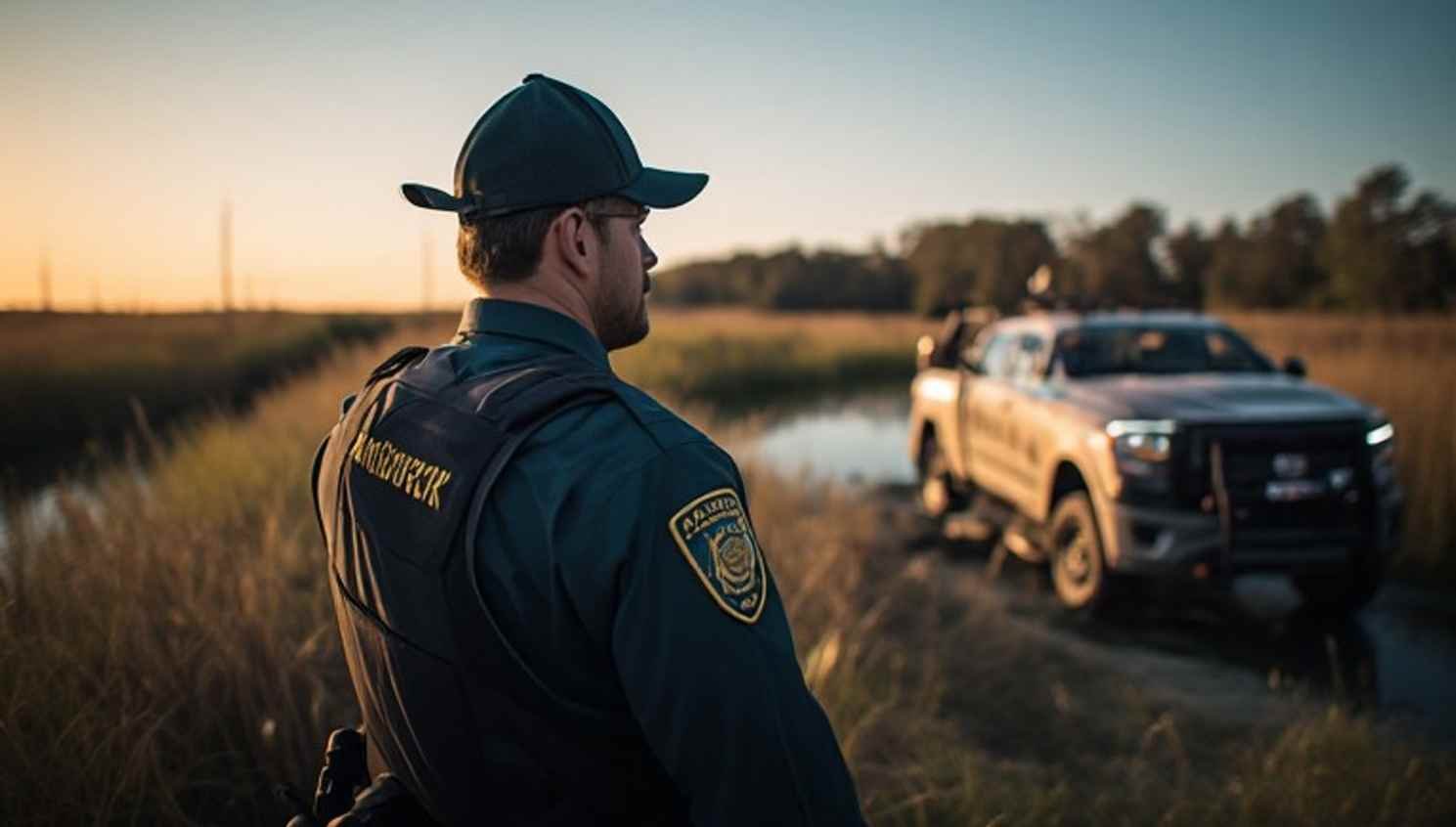
Delaware Game Warden: Natural Resources Police Officer Requirements & Jobs
In Delaware, the person most people call a “game warden” is officially titled a Delaware Natural Resources Police Officer and, when assigned to the Fish and Wildlife Unit, serves as the state’s hunter, angler, and boater enforcement officer. Delaware’s Natural Resources Police (NRP) sit inside the Department of Natural Resources and Environmental Control (DNREC) and operate as a full-service state law enforcement agency that patrols wildlife areas, public fishing ponds, state-owned boating access points, and Delaware’s tidal and non-tidal waters. Because Delaware is small, one NRP officer’s beat often blends wetland patrol, marine police work, and criminal investigation in the same shift.
If you want to become a Delaware game warden, you apply through the State of Delaware’s recruiting portal, must be at least 20½ years old, must hold either an associate’s degree in a qualifying field or a high school diploma plus relevant experience, and must pass Delaware’s Police Academy along with a physical fitness test and a water confidence assessment. The current official job posting lists a starting salary range of $62,640–$84,918 with 5% night-shift differential pay and full state benefits.
What Is a Delaware Game Warden Called?
Delaware does not have a standalone “Game Warden Division.” Instead, the state uses the umbrella title Natural Resources Police Officer (NRP) under DNREC, and officers are then assigned to one of three units:
- Fish and Wildlife Unit — the role commonly called “game warden”: hunting, fishing, and boating enforcement, plus wildlife protection
- State Parks Unit — patrol and law enforcement inside Delaware’s state parks and park-owned water
- Environmental Crimes Unit (ECU) — investigation of environmental crimes, hazardous material response, and complex regulatory cases
So while Delaware’s official job title on the pay stub is Natural Resources Police Officer I, II, or III, the public-facing label everyone uses for someone enforcing Delaware hunting and fishing laws is “game warden.” This matters because it shifts how you search for jobs: the official state postings appear under “Natural Resources Police,” not under “game warden,” and that’s the language your application has to use to get noticed.
The agency’s three-unit model is also why an “Environmental Crimes Unit” officer can answer a Delaware hunting call if Fish and Wildlife is stretched thin — a unique structural difference compared with neighboring states that silo conservation enforcement into a single division.
What Does a Delaware Natural Resources Police Officer Do?
Within the Fish and Wildlife Unit, Delaware NRP officers handle a much broader workload than most states pack into a “game warden” job description. Official DNREC duty statements list the following as core functions:
- Hunting-law enforcement — spot-checking hunters in wildlife areas, checking licenses, tagging, and bag limits
- Fishing-law enforcement — patrol of tidal and non-tidal waters, license checks, creel and size limits
- Boating enforcement — BUI, navigation rules, life-jacket compliance, accident response, boating safety education
- Wildlife protection — including protected species under Delaware Code Title 7, Chapter 6 and the Interstate Wildlife Violator Compact
- Investigations — interviews, evidence gathering, search and arrest warrants, prosecution support
- Poaching and illegal possession — including night-hunting spotlight cases and out-of-season take
- License violations — hunting, fishing, and trapping license checks via the DNREC ePermitting system
- Court testimony — presenting evidence at Justice of the Peace and Superior Court hearings
- Public safety and search and rescue — including maritime Homeland Security missions on Delaware’s waterways
- Education and outreach — school programs, hunter and boating safety courses, HOA meetings, public K-9 demonstrations (one fish and wildlife officer, Corporal Joshua Hudson, also runs a detection and tracking K-9 named “Rosco”)
Delaware officers regularly back up Delaware State Police, county police and municipal departments, which effectively turns a “fish and wildlife” posting into a general-policing role when needed.
Delaware Game Warden Requirements
Because the official title is Natural Resources Police, requirements come straight from the DNREC recruitment page and the State of Delaware job specifications.
Age
You must be at least 20½ years old to enter the Police Academy track. There is no published upper age limit, but you must be able to pass the physical ability test and water confidence test.
Education
You must meet one of these two tracks:
- Associate’s degree or higher in criminal justice, natural resources, environmental science, sociology, or a related field, OR
- High school diploma or equivalent plus six months of experience in each of the following:
- Conducting investigations (interviews, evidence, documentation)
- Applying natural resources laws, rules, and regulations
- Narrative report writing
Most recruits come in with the associate’s degree option. Environmental Health Science, Marine Biology, and Environmental Science are common majors — one current Fish and Wildlife Corporal majored in Environmental Health Science with a Biology minor at Salisbury University.
Citizenship / Work Authorization
Applicants must be legally authorized to work in the United States. DNREC does not sponsor H-1B visas. The agency also participates in the federal E-Verify system.
Driver’s License
You must hold a valid driver’s license that has not been suspended, revoked, or cancelled, and you must not be disqualified from driving. Delaware NRP officers drive unmarked patrol trucks, ATVs, watercraft, and trailers, so a clean driving record matters.
Residency
Delaware’s posting does not list state residency as a hard requirement, but as a state agency you will become a Delaware resident within a reasonable period. Preference is typically shown to candidates who already live in or are familiar with the state’s wildlife areas, tidal marshes, and Chesapeake & Delaware Canal beats.
Work Experience
For entry-level Officer I postings, experience is waived if you hold the qualifying associate’s degree. Six months of investigation, natural-resources regulation, and report-writing experience substitute for the degree. For Officer II and III, you need progressively more law-enforcement experience and demonstrated public-relations and training-presentation skills.
Background Check
A satisfactory criminal background check is required as a condition of hire, and applicants may be required to pay the cost as part of a conditional offer. Prior felony convictions, certain misdemeanors, or recent pattern of violations will disqualify you.
Physical Requirements
To enter the academy you must pass the DNREC Physical Fitness Test:
- One-minute sit-ups
- One-minute push-ups (modified push-ups permitted for female applicants)
- 1.5-mile run
- The DNREC Water Confidence Assessment: 100-yard swim, five-minute tread in 7+ feet of water, and a headfirst surface dive to retrieve an object at 7–12 feet
Medical Requirements
After a conditional offer, you must pass a State of Delaware Council on Police Training-approved medical examination plus a psychiatric/psychological exam.
Vision and Hearing Requirements
Delaware follows the Council on Police Training medical standards; applicants must demonstrate adequate corrected vision and hearing for firearms qualification, marine radio use, and patrol duty. Exact diopter and decibel thresholds are reviewed individually by the examining physician.
Firearm Requirements
You must qualify annually with the duty handgun (and shotgun/rifle where assigned) under the State of Delaware Police Academy certified firearms program. Demonstrated safe handling is taught and assessed during academy; you are not required to own a firearm before applying.
Delaware Game Warden Salary
Pay information comes from two official Delaware sources: the DNREC Enforcement Career Path page and active job postings on Delaware’s employment portal.
Starting / Trainee Salary
- Natural Resources Police Trainee (Pay Grade 7/C07) — $53,807/year as listed in a recent Trainee — State Parks Unit posting. This is the rate during academy and initial field training.
- Natural Resources Police Officer I (Pay Grade 9A) — advertised at $43,084.02/year in a 2022 officer-class posting; pay scales are revised by Delaware’s merit system each fiscal cycle.
Experienced Officer Pay
- Officer II (Pay Grade 10A) — $48,254.10/year
- Officer III (Pay Grade 11A) — $54,044.59/year
- Sergeant (Pay Grade 12) — next rung after Officer III
- Lieutenant (Pay Grade 13)
- Captain (Pay Grade 16)
- Chief (Pay Grade 18) — top of the NRP ladder
The current active DNREC / Natural Resources Police job posting lists the overall salary range as $62,640–$84,918, which reflects current pay-grade adjustments plus built-in step increases tied to length of service.
Overtime / Bonuses
- Shift differential: 5% added when four or more hours of a shift fall between 6 p.m. and 8 a.m.
- Step increases: Pay bumps when an officer meets requirements for skill-building, full-performance, and expert levels
- Overtime is paid for special deployments (Hurricane response, special hunts, security details, court overtime)
Benefits
- Comprehensive medical and dental insurance
- State pension through the State Municipal Police Pension
- Vacation accrues at 9.5 hours per month with rate increases by length of service
- Paid sick leave, parental leave, and state holidays
- Public Service Loan Forgiveness (PSLF) eligibility
- Collective bargaining through FOP Lodge 1 (Fraternal Order of Police)
Retirement
Delaware NRP officers are covered by the State Municipal Police Pension, with a defined-benefit structure and retirement eligibility based on age and years of service as a sworn officer. FOP Lodge 1 collective bargaining influences benefit terms.
How to Become a Delaware Game Warden
The path runs through Delaware’s standard state-police hiring pipeline, then branches into the Fish and Wildlife Unit at assignment.
- Confirm eligibility — 20½+ years old, qualifying education or equivalent experience, valid driver’s license, no disqualifying criminal history.
- Prepare your education and experience — an associate’s degree in criminal justice, natural resources, or environmental science is the cleanest path.
- Submit application through the Delaware Employment Link when a posting is open.
- Pass initial screening — supplemental questionnaire scored against job requirements.
- Take the physical fitness test — sit-ups, push-ups, 1.5-mile run.
- Pass the Water Confidence Assessment — 100-yard swim, 5-minute tread water, headfirst surface dive.
- Interview with the DNREC hiring panel.
- Background investigation — criminal, driving, employment, references.
- Medical, psychological, and drug screening post-conditional offer.
- Attend the State of Delaware Police Academy and complete field training, then graduate to probationary Officer I status with a Fish and Wildlife assignment.
Delaware does not run a separate “game warden academy” — Fish and Wildlife officers complete the same Council on Police Training-approved academy as Delaware State Police recruits, then layer on specialized Fish and Wildlife instruction in field training.
Delaware Game Warden Application Process
Delaware posts vacancies through two official channels. You should monitor both:
- Delaware Employment Link / jobapscloud.com — statewide job portal with filtering by agency
- statejobs.delaware.gov — DNREC’s career page with the latest Fish and Wildlife officer and trainee postings
Required documents typically include a fully completed State of Delaware application, supplemental questionnaire responses, education transcripts, professional references, and (post-conditional offer) proof of identity and work authorization. The recruitment contact is DNREC Applicant Services at 302-739-9901. Recruitment cycles are not on a fixed annual schedule — they open when DNREC has an actual vacancy, so set up saved searches and alerts rather than waiting for a specific month.
At the State Parks Unit Trainee posting, applicants must also pass the trainee physical and water standards before academy admission.
Delaware Game Warden Physical Fitness Test
DNREC publishes age- and gender-specific minimum scores for the Physical Fitness Test. No second attempts are allowed if you fail any single element on the first try, so train to the standard before testing.
One-Minute Sit-Up Minimums
| Age | 20–29 | 30–39 | 40–49 | 50–59 | 60+ |
|---|---|---|---|---|---|
| Male | 33 | 30 | 24 | 19 | 15 |
| Female | 24 | 20 | 14 | 10 | 3 |
One-Minute Push-Up Minimums
| Age | 20–29 | 30–39 | 40–49 | 50–59 | 60+ |
|---|---|---|---|---|---|
| Male | 22 | 17 | 11 | 9 | 6 |
| Female | 10 | 8 | 6 | N/A | N/A |
| Female (Modified) | 17 | 11 | 6 | 6 | 2 |
1.5-Mile Run — Maximum Time Allowed
| Age | 20–29 | 30–39 | 40–49 | 50–59 | 60+ |
|---|---|---|---|---|---|
| Male | 14:06 | 14:34 | 15:32 | 17:30 | 19:10 |
| Female | 16:46 | 17:38 | 19:43 | 21:57 | 22:44 |
Water Confidence Assessment
- 100-yard swim — any stroke, no side/bottom rest (untimed)
- Five-minute tread water in at least 7 feet of water — arms and legs pumping, head above surface, floating does not count
- Headfirst surface dive to retrieve an object from 7–12 feet of water — up to three attempts
Delaware Game Warden Academy and Training
All Delaware Natural Resources Police officers attend the State of Delaware Police Academy, which runs a 920-hour Council on Police Training-certified curriculum. Recruits who then go to the Fish and Wildlife Unit get additional unit-specific field training covering:
- Firearms and use-of-force
- Wildlife law and Delaware Code Title 7
- Boating safety and maritime navigation
- Wildland and water rescue fundamentals
- First aid, CPR, and tactical medicine
- Physical conditioning
- Court testimony, report writing, and evidence handling
- Field training program under a senior Fish and Wildlife officer
Acceptance into the academy requires the conditional-offer medical, psychological, and physical ability tests in addition to graduation.
Delaware Game Warden Jobs
Fish and Wildlife Unit vacancies are posted on the same Delaware state-jobs portal used by every other state agency. There is no separate “game warden” hiring website. Because the official title is “Natural Resources Police,” you have to search that term inside the Delaware jobs filter.
Candidates should expect:
- Entry-level openings through Trainee and Officer I postings
- Actual vacancies filtered by location (Kent, Sussex, or New Castle County)
- Rotating shifts, weekends, and holidays required
- Applications accepted only when an active posting is open
Setting up saved-search alerts on the Delaware Employment Link and watching DNREC’s announcements is the fastest way to catch an opening.
Delaware Game Warden Benefits
Official benefits, published on the Join Delaware State Government portal and the DNREC recruitment page, include:
- Comprehensive medical and dental insurance
- State Municipal Police Pension retirement plan
- 9.5 hours/month vacation accrual, scaling up with tenure
- Paid sick leave and parental leave
- State holidays
- 5% night-shift differential pay
- Public Service Loan Forgiveness eligibility through state employment
- FOP Lodge 1 collective bargaining representation
- Issued uniforms, duty gear, firearms, state vehicle (take-home patrol truck) and assigned watercraft for Fish and Wildlife officers
- Training and tuition support for continuing education
Housing is not provided; officers live within reasonable commuting distance of their assigned county.
What Laws Do Delaware Game Wardens Enforce?
Delaware Fish and Wildlife Unit officers enforce Delaware Code Title 7 — Conservation, which covers game, wildlife, freshwater fish, shellfish, and boating under tidal and non-tidal waters. Common enforcement categories include:
- Hunting violations — out-of-season take, over-bag, untagged harvest, hunting without a license
- Fishing violations — creel limits, size limits, illegal gear, license and license-stamp violations
- Trapping violations — illegal sets, untagged furbearers, closed-trap dates
- Wildlife violations — taking protected species, illegal possession of live wildlife, exotic-pet violations
- Boating violations — BUI, navigation rules, life-jacket noncompliance, accident reporting
- License violations — hunting, fishing, and Chesapeake Bay fishery license requirements
- Interstate Wildlife Violator Compact suspensions — Delaware honors out-of-state revocations
- Environmental crimes — handled jointly with or escalated to the Environmental Crimes Unit
How to Find a Delaware Game Warden
DNREC does not publish a public officer-by-county directory the way some states do. The most reliable method is to contact the Fish and Wildlife Unit directly:
- DNREC main phone: (302) 739-9913
- DNREC building: 89 Kings Highway, Dover, DE 19901 — officers are typically present from 12 p.m.–8 p.m.
- County listings: Officers are assigned by county (New Castle, Kent, Sussex). Calling the main number and asking for the Fish and Wildlife officer assigned to your county puts you in touch quickly.
For non-emergency wildlife or boating questions, the agency’s public information line during business hours, or county-level dispatch after hours, will route you to the on-duty Fish and Wildlife officer.
How to Report a Hunting or Wildlife Violation in Delaware
Delaware provides multiple official channels for reporting poaching and wildlife crime. Choose whichever is easiest; tips can be anonymous.
| Reporting Method | Contact | Best For |
|---|---|---|
| Operation Game Theft hotline | 800-292-3030 | Anonymous 24/7 poaching tips |
| Online tip portal | de.gov/ogt | Online submission of detailed tips |
| DENRP Tip | Text FWTIP to 847411 (TIP411) | Quick mobile text tips |
| Fish & Wildlife violation line | 800-523-3336 | Non-emergency reporting during business hours |
| Boating emergencies | 911 or DNREC main line (302) 739-9913 | Boating under the influence, accidents, in-progress violations |
Operation Game Theft is Delaware’s official anti-poaching program run by DNREC. Rewards are available for tips leading to a conviction.
Delaware Game Warden vs. Police Officer
A Delaware Natural Resources Police Officer who works the Fish and Wildlife Unit is a sworn state law enforcement officer, not a regulatory civilian. Their authority is the same as any Delaware post: full arrest power, authority to execute warrants, carry firearms, and present evidence in court. The practical difference is jurisdiction focus.
- Police officers (municipal, Delaware State Police, county) concentrate on criminal, traffic, and civil enforcement in their geographic jurisdiction.
- Delaware NRP Fish & Wildlife officers concentrate on Title 7, Title 17, and Title 23 violations — hunting, fishing, boating, environmental, and wildlife crime — but they also answer general calls and routinely back up other agencies on criminal matters.
Because Delaware’s population is small and its waterways cut through multiple jurisdictions, the Fish and Wildlife Unit frequently handles mixed calls. This makes the NRP career path one of the most varied conservation-law enforcement jobs in the Northeast.
Frequently Asked Questions
What is a game warden called in Delaware?
They are officially called Natural Resources Police Officers. Within the Department of Natural Resources and Environmental Control (DNREC), officers assigned to the Fish and Wildlife Unit serve the role most people call “game warden.”
How much does a Delaware game warden make?
Trainees start around $53,807 per year, with current job postings showing an overall NRP officer salary range of $62,640–$84,918. Experienced officers and sergeants can reach the upper end of the range plus shift differential.
How do I become a game warden in Delaware?
Apply through the Delaware Employment Link when a Natural Resources Police posting is open, pass the physical fitness test, water confidence assessment, background investigation, and medical/psychological screening, then complete the State of Delaware Police Academy.
What are the Delaware game warden age requirements?
You must be at least 20½ years old to enter the academy. There is no published maximum age.
What degree do you need to become a game warden in Delaware?
An associate’s degree or higher in criminal justice, natural resources, environmental science, sociology, or a related field satisfies the education requirement. A high school diploma plus six months of qualifying investigation, regulation, and report-writing experience is also accepted.
Is there a physical test?
Yes. The Physical Fitness Test covers sit-ups, push-ups, and a 1.5-mile run with age- and gender-specific minimums, plus a Water Confidence Assessment (100-yard swim, 5-minute tread water, headfirst surface dive).
Where do Delaware game wardens work?
Fish and Wildlife officers are assigned by county — New Castle, Kent, or Sussex — and patrol Delaware’s wildlife areas, state-owned fishing ponds and piers, public boating access sites, and tidal and non-tidal waterways.
How do I contact/report a Delaware game warden?
Call the Fish and Wildlife violation line at 800-523-3336, text FWTIP to 847411, file an online tip at de.gov/ogt, or call Operation Game Theft at 800-292-3030 for anonymous poaching reports. For non-emergency general contact, dial (302) 739-9913.
Can a Delaware game warden arrest someone?
Yes. As sworn state law enforcement officers under Delaware Code Title 7, Chapter 13, NRP officers have full arrest authority for violations of the laws they enforce and full backup authority for general criminal matters.
What laws do Delaware game wardens enforce?
Primarily Delaware Code Title 7 — Conservation — covering hunting, fishing, trapping, wildlife, boating, and the Interstate Wildlife Violator Compact, plus delegated environmental criminal statutes.