

Massachusetts Boating License Guide 2026–2027
Do You Need a Boating License in Massachusetts in 2026–2027?
Yes — as of April 1, 2026, a valid Boater Safety Certificate is required to legally operate any motorboat or personal watercraft (PWC) in Massachusetts. This applies to all ages, with a phased rollout based on birth year under the Hanson-Milone Boater Safety Act. You must be at least 12 years old to operate a motorboat (with restrictions) and 16 years old to operate a PWC. The certificate never expires. Online courses cost between $30–$80, while MEP-taught in-person classes are free. You carry the card aboard at all times. No renewal is required once certified. The Massachusetts Environmental Police (MEP) administers the program. Penalties begin September 1, 2026.
Recent Changes for 2026–2027
Massachusetts boating law has seen its most significant overhaul in decades. Here is what changed and when.
Key 2026 Regulatory Changes
| Change | Effective Date | Impact |
|---|---|---|
| Hanson-Milone Boater Safety Act signed into law | January 8, 2025 | Established mandatory statewide boater certification |
| Boater Safety Certificate required (born after Jan 1, 1989) | April 1, 2026 | All such operators must now be certified |
| Penalty enforcement begins (born after Jan 1, 1989) | September 1, 2026 | $50 first offense, $100 subsequent |
| Boater Safety Certificate required (born on/before Jan 1, 1989) | April 1, 2028 | Older operators have additional runway |
| PWC minimum age reinforced as absolute rule | April 1, 2026 | 16 years minimum — no certificate workaround |
| Non-enforcement grace period | April 1 – August 31, 2026 | Officers educate but do not fine |
What did NOT change: Age requirements for motorboat operation (minimum 12), the requirement to register all motorized vessels, life jacket rules by age and activity, BUI thresholds, and speed regulations remain unchanged.
| Born | Certification Deadline | Penalty Start Date | Status |
|---|---|---|---|
| After Jan 1, 1989 | April 1, 2026 | September 1, 2026 | Deadline Passed — Get Certified Now |
| On/Before Jan 1, 1989 | April 1, 2028 | April 1, 2028 | Deadline Approaching |
| Ages 12–15 (any DOB) | Required now for unsupervised ops | September 1, 2026 | Required for Independence |
| Ages 16–17 (PWC) | Required now | September 1, 2026 | Must Hold Certificate |
| Under 12 | Cannot operate motorboat independently | N/A | Always Requires Adult Supervision |
| Under 16 | Cannot operate PWC — no exceptions | N/A | PWC Prohibited |
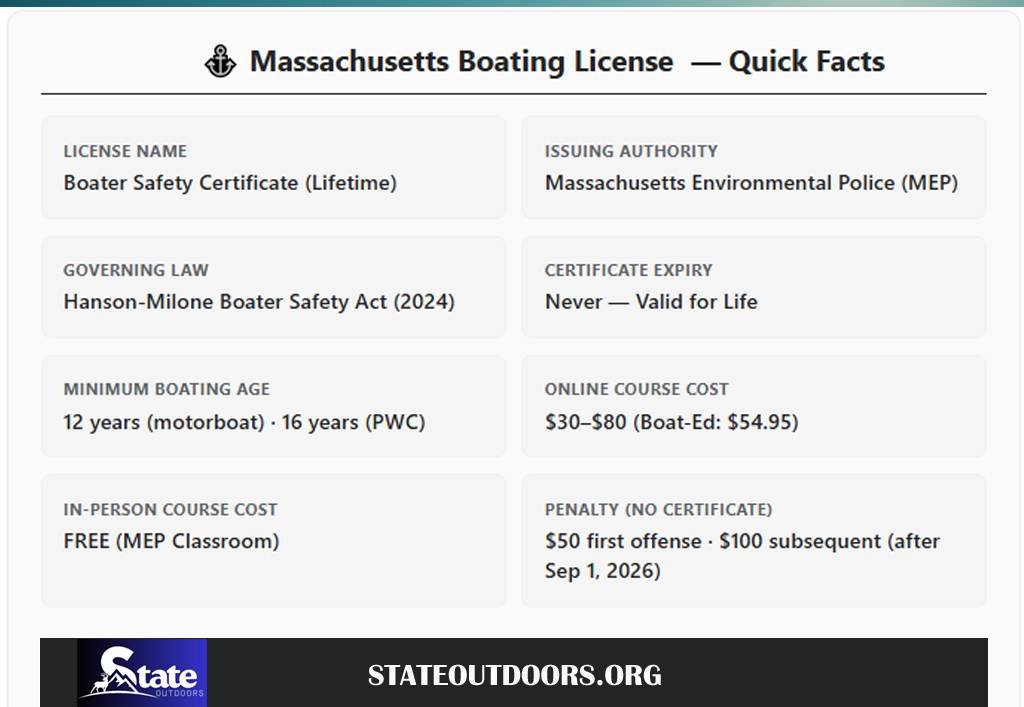
Quick Facts Table
(See the interactive table above for the at-a-glance summary.)
| Requirement | Details |
|---|---|
| Certificate Name | Massachusetts Boater Safety Certificate |
| Governing Law | Hanson-Milone Boater Safety Act (Chapter 350, Acts of 2024) |
| Issuing Authority | Massachusetts Environmental Police (MEP) |
| Minimum Age — Motorboat | 12 years old |
| Minimum Age — PWC | 16 years old (no exceptions) |
| Certificate Validity | Lifetime — never expires |
| Enforcement Start | September 1, 2026 (born after Jan 1, 1989) |
| In-Person Course Cost | Free (MEP-taught) |
| Online Course Cost | $30–$80 depending on provider |
| Permanent Card Delivery | 4–6 weeks by mail |
| Temporary Certificate | Printable immediately after passing exam |
| Replacement Card | Visit ilostmycard.com |
| Boat Insurance Required by Law | No — but strongly recommended |
| Registration Renewal | Every 2 years (biennial) |
Who Must Have a Boating Education Certificate?
Massachusetts now requires every operator of a motorboat or PWC to carry a valid Boater Safety Certificate when on the water. The rollout is phased by birth year.
Age-Based Eligibility and Requirement Grid
| Age Group | Motorboat Operation | PWC Operation | Certificate Required? |
|---|---|---|---|
| Under 12 | Only with direct adult supervision (18+) on board | Not allowed | Not applicable |
| 12–15 | Independently only with certificate; otherwise, adult supervision required | Not allowed (under 16) | Yes, for unsupervised operation |
| 16–17 | Independently with certificate | Allowed with certificate (16+) | Yes |
| 18+ (born after Jan 1, 1989) | Independently with certificate | Allowed with certificate | Yes — deadline: April 1, 2026 |
| 18+ (born on/before Jan 1, 1989) | Independently with certificate | Allowed with certificate | Yes — deadline: April 1, 2028 |
Key rule for supervision: The supervising adult must be 18 or older, hold a valid Boater Safety Certificate, be physically capable of operating the vessel, and maintain visual and verbal contact with the operator at all times. They may not be under the influence of alcohol or any impairing substance.
Who Is Exempt from the Boating Safety Certificate?
The Hanson-Milone Act lists specific exemptions. Importantly, if you qualify for an exemption, you still need to carry documentation proving your eligibility aboard the vessel.
Exemption Checklist
- ✅ Valid U.S. Coast Guard Merchant Mariner Credential — Must carry the credential on board
- ✅ Non-residents with a valid out-of-state certificate — Must be from any U.S. state, territory, or Canadian province (NASBLA-recognized); must carry the card on board
- ✅ Active military/National Guard/USCG members — Must be qualified through their training and position; documentation required
- ✅ New boat owners (within 6 months of purchase) — If the vessel is registered in Massachusetts and the operator holds a temporary certificate
- ✅ Commercial fishing vessel operators — Subject to the Commercial Fishing Industry Vessel Safety Act of 1988
- ✅ Participants in an approved boating safety program — Must be actively enrolled
- ✅ Secondary/maritime school students — Operating as part of an approved instructional course
- ✅ Operators of non-motorized vessels — Kayaks, canoes, paddleboards, and rowboats without a motor
- ✅ Supervised operators (12+) — A person 12 or older may operate without a certificate if directly supervised by a certified adult (18+) who is on board
- ❌ Massachusetts residents cannot use an out-of-state certificate when operating on Massachusetts waters; they must obtain a Massachusetts certificate or convert their out-of-state one
Note on out-of-state conversion: If you are a Massachusetts resident who previously certified in another state, MEP offers an Out-of-State Certificate Conversion form. Submit a copy of your current out-of-state certificate to apply for recognition.
Boating License Cost in Massachusetts
One of the most misunderstood facts about Massachusetts boating: the state itself charges no fee for the certificate. Costs come from the course provider you choose. Here is a complete breakdown.
Complete Fee Table
| Item | Cost | Notes |
|---|---|---|
| MEP Classroom Course | Free | 10–12 hrs; registration required; fills quickly |
| Boat-Ed Online Course | $54.95 | NASBLA-approved; official MEP delegated provider |
| iLearnToBoat Online Course | ~$44.95–$64.95 | Delegated MEP provider; no timers |
| Other Approved Online Providers | $30–$80 | Varies by platform |
| Temporary Certificate (after passing) | $0 | Print immediately online |
| Permanent Certificate Card | $0 | Mailed 4–6 weeks after completion |
| Replacement Card | Varies (via ilostmycard.com) | Contact MEP at (508) 564-4961 if issues |
| Out-of-State Certificate Conversion | $0 | Submit via MEP’s online form |
Boat Registration Fees (Biennial — Every 2 Years)
| Vessel Length | Registration Fee | Validity |
|---|---|---|
| Under 16 feet | $44 | 2 years |
| 16 feet to less than 26 feet | $66 | 2 years |
| 26 feet to less than 40 feet | $88 | 2 years |
| 40 feet and greater | $110 | 2 years |
| Boat Title (new) | $27.50 | Until sold/transferred/destroyed |
| Duplicate Title | $16.50 | Until sold/transferred/destroyed |
| Adding a Lien Holder | $16.50 | Per lien |
Sales Tax: Massachusetts charges 6.25% sales tax on boat purchases, due by the 20th of the month following the purchase date.
How to Get a Boating License in Massachusetts: Step-by-Step
Getting your Massachusetts Boater Safety Certificate is straightforward. Here is the complete process whether you choose online or in-person.
For Online Courses
Step 1: Choose an Approved Provider
Select a Massachusetts Environmental Police-approved online course (see the course comparison table below). Ensure the provider carries NASBLA accreditation.
Step 2: Create an Account & Register
Sign up on the provider’s website. Provide your name, date of birth, and contact information. Payment is collected at registration.
Step 3: Complete the Course at Your Own Pace
Online courses are fully self-paced and available on any device — smartphone, tablet, or computer. The Boat-Ed course takes approximately 3–5 hours. Your progress is saved automatically.
Step 4: Pass the Final Exam
You must score at least 80% on the final exam. You have unlimited attempts. If you fail a unit quiz, restudy that section and retake it.
Step 5: Print Your Temporary Certificate
Immediately after passing, print your temporary Boater Safety Certificate. This is valid for 365 days and allows you to operate legally while waiting for your permanent card.
Step 6: Receive Your Permanent Card by Mail
Your hard plastic, lifetime Boater Safety Certificate arrives by mail within 4–6 weeks.
For In-Person (MEP Classroom) Courses
Step 1: Check the MEP Boating Safety Course Schedule
Visit the MEP course schedule on mass.gov. Classes are offered throughout Massachusetts and open for registration 30 days before the class date.
Step 2: Register in Advance
Class sizes are limited. Pre-registration is mandatory — walk-ins are not accepted. If a class fills, you can join the waitlist.
Step 3: Attend the Full Course
In-person classes run 10–12 hours, typically spread over several sessions. Course content is identical to online programs and covers navigation rules, emergency procedures, and Massachusetts-specific regulations.
Step 4: Pass the Final Exam
Both formats include a final exam. Grading standards are the same as online courses.
Step 5: Receive Your Certificate
A temporary certificate is emailed once the instructor submits results. The permanent card arrives approximately 4–6 weeks later.
Where to Buy / Get a Boating License Online
The official hub for Massachusetts boating certification is mass.gov/how-to/boat-safety-certificate-course. Below is a comparison of your approved options.
Approved Course Providers — Comparison Table
| Provider | Format | Cost | Time to Complete | Notes |
|---|---|---|---|---|
| Boat-Ed (Official MEP Delegated) | Online | $54.95 | ~3–5 hrs self-paced | Available in English & Spanish; print temp card immediately |
| iLearnToBoat (MEP Delegated) | Online | ~$44.95–$64.95 | Self-paced, no timers | Fast; delegated MEP provider |
| MEP Classroom — “Boat Massachusetts” | In-Person | Free | 10–12 hrs | NASBLA accredited; family participation encouraged |
| BoatUS Foundation | Online | Free | Self-paced | NASBLA approved; accepted in MA |
| Other MEP-Approved Partners | Online/In-Person | $30–$80 | Varies | Must be on MEP’s official approved list |
Pro tip: If cost is a concern, the MEP’s in-person “Boat Massachusetts” course is completely free and equally valid. The only tradeoff is flexibility — you need to register ahead and attend scheduled sessions.
If you already hold a boating license from another state and are planning to boat in Massachusetts waters, check out our guide on Connecticut boating license requirements to understand how reciprocity works across New England states.
Required Documents
For Course Enrollment
- ✅ Government-issued photo ID (driver’s license, passport, or state ID)
- ✅ Date of birth confirmation
- ✅ Payment method (for online courses)
- ✅ Valid email address (for temporary certificate delivery)
For First-Time Boat Registration
- ✅ Bill of Sale (must include seller’s name, address, and signature)
- ✅ Manufacturer’s Statement of Origin (for new boats from a dealer)
- ✅ Proof of sales tax payment (from MassTaxConnect)
- ✅ Pencil tracing or digital photo of the Hull Identification Number (HIN)
- ✅ Completed Registration and Titling Application
- ✅ Payment (check, money order, or credit/debit card — no cash)
- ✅ Title signed over to the buyer (for boats 14 feet and over from private sales)
- ✅ Commercial fishing license copy (if registering strictly for commercial fishing)
Processing Time
| Step | Timeframe |
|---|---|
| Complete online course | A few hours (self-paced) |
| In-person MEP course | 10–12 hours over 1–2 sessions |
| Temporary certificate (online course) | Immediately — print right after passing |
| Temporary certificate (in-person) | Emailed after instructor submits results |
| Permanent hard plastic card (mail) | 4–6 weeks after course completion |
| Replacement card processing (ilostmycard.com) | Varies — contact MEP at (508) 564-4961 |
| Out-of-State Certificate Conversion | Varies — submit via MEP’s online form |
| First-time boat registration | Same-day at any of the 5 registration offices |
Boating Laws and Rules for 2026–2027
All of the following rules are enforced by the Massachusetts Environmental Police. Ignorance of the law is not a legal defense — knowing these before you launch can save you from costly fines or worse.
Life Jacket (PFD) Requirements
| Who | Requirement |
|---|---|
| All vessels | Must carry one USCG-approved wearable PFD per person on board |
| Vessels 16 feet and over | Must also carry a throwable Type IV PFD (readily accessible) |
| Children under 12 | Must wear a PFD at all times on any vessel |
| PWC operators and passengers | Must wear an approved PFD at all times |
| Water-skiers and tubers | Must wear a PFD while being towed |
| Canoeists and kayakers | Must wear a PFD from September 15 – May 15 |
PFDs must be Coast Guard-approved, in good and serviceable condition, and the correct size for the wearer. Inflatables are not permitted for PWC riders.
Speed and Distance Regulations
| Situation | Rule |
|---|---|
| Inland waters (general) | Maximum 45 mph |
| Within 150 feet of a swimming area shoreline | Prohibited — no operation allowed |
| 150 to 300 feet from swimming shoreline | Headway speed only (6 mph or less) |
| Within 150 feet of swimmers, marinas, boat launches, rafts, floats | Headway speed only |
| Within 300 feet of a public access boat ramp | Headway speed only |
| In a channel | Headway speed only (unless channel markers state otherwise) |
| When vision is obscured (bends, bridges, etc.) | Headway speed only |
| Creating a wake that causes damage or excessive rocking | Prohibited |
Headway speed is defined in Massachusetts law as no more than 6 miles per hour — the minimum speed needed to maintain steerage while not creating a damaging wake.
Alcohol and BUI Restrictions
Massachusetts treats Boating Under the Influence (BUI) — also called OUI (Operating Under the Influence) — with the same seriousness as drunk driving.
| Threshold | Consequence |
|---|---|
| Blood Alcohol Concentration (BAC) ≥ 0.08% | Legally presumed impaired — BUI |
| First-offense BUI conviction | Up to $1,000 fine and/or up to 30 months imprisonment |
| BUI causing serious injury or death | Up to $5,000 in fines and up to 10 years imprisonment |
| Any BUI conviction | Possible loss of driver’s license + loss of vessel registration |
| Operating while impaired by drugs | Same penalties as alcohol BUI |
If a boating accident results in serious injury and the operator is found to be impaired, consulting a maritime attorney is strongly advisable. Legal representation can significantly affect the outcome of personal injury claims.
Navigation Lights (Night Operation)
| Requirement | Rule |
|---|---|
| Navigation lights display period | Sunset to sunrise, and in restricted visibility |
| Blue or red flashing lights | Restricted to law enforcement vessels only |
| Towing waterskiers at night | Prohibited in Massachusetts |
| Improperly functioning navigation lights | Prohibited — enforced by MEP |
Personal Watercraft (PWC) Specific Rules
Beyond general boating laws, Massachusetts enforces additional regulations specific to jet skis and other personal watercraft:
- ✅ Must wear an approved PFD at all times (operator and all passengers)
- ✅ Safety lanyard must be attached to the operator and the engine cutoff/kill switch
- ✅ Minimum age: 16 — no exceptions under any circumstances
- ✅ Must hold a valid Boater Safety Certificate (as of April 1, 2026)
- ❌ Cannot operate between sunset and sunrise
- ❌ Cannot operate on waters under 75 acres in total area
- ❌ Cannot tow persons on skis, tubes, or similar devices
- ❌ Cannot operate at high speed in congested areas
- ❌ Cannot operate within 150 feet of a swimmer, shoreline, boat launch, raft, or moored vessel at more than headway speed
- ❌ Cannot operate under the influence of alcohol or drugs
Additional Prohibited Operations
| Prohibited Action | Notes |
|---|---|
| Overloaded vessel | Cannot exceed capacity plate weight recommendations |
| Passengers on bow, gunwales, or any location where falling overboard is possible | Strictly prohibited |
| Operating without working navigation lights | Enforced by MEP |
| All vessels must have an anchor, manual bailer, and line | Except PWCs |
| Boats under 16 feet must carry a paddle or oar | Required equipment |
Accident Reporting Requirements
If you’re involved in a boating accident in Massachusetts that causes personal injury, death, or property damage over $500, you must:
- Immediately notify the Massachusetts Environmental Police
- File an accident report within 2 days if the accident resulted in a fatality or disappearance
- File within 5 days for all other accidents meeting the threshold
Penalties and Fines
| Violation | Penalty |
|---|---|
| Operating without a Boater Safety Certificate (first offense) | $50 fine |
| Operating without a Boater Safety Certificate (second/subsequent) | $100 fine |
| BUI (first offense) | Up to $1,000 fine and/or up to 30 months imprisonment |
| BUI causing serious injury or death | Up to $5,000 fine and up to 10 years imprisonment |
| Negligent operation (inland waters over 45 mph) | Fine + potential criminal charges |
| Operating in a restricted swimming area (within 150 ft) | Enforced by MEP |
| No PFD for required passengers (children under 12, PWC riders, etc.) | Enforced by MEP |
| Failure to report a qualifying boating accident | Up to $500 fine |
| Violation of marine environmental laws | Up to $50,000 fine, imprisonment, and/or vessel seizure |
| Boater safety certificate enforcement begins | September 1, 2026 (no penalties before this date for those born after Jan 1, 1989) |
Note: ALL boating violations are arrestable under MGL Chapter 90B, Section 13. Non-criminal disposition is at the officer’s discretion under MGL Chapter 21, Section 6F.
Boat Registration Requirements
All boats propelled by machinery — including electric motors — must be registered in Massachusetts. There is no boat title requirement for most vessels, but specific documentation is required.
Registration Comparison Chart
| Registration Type | Who Needs It | Cost | Validity | Key Documents |
|---|---|---|---|---|
| First-time registration (private purchase) | All motorized vessels new to MA | $44–$110 (by length) | 2 years | Bill of sale, HIN photo/tracing, proof of sales tax, application |
| First-time registration (new from dealer) | New boat buyers | $44–$110 | 2 years | Manufacturer’s Statement of Origin, sales tax proof, application |
| Renewal registration | All registered motorized vessels | Same fee structure | 2 years | Current registration, payment |
| Government agency vessel | City/county/state/federal use | Free | 2 years | Agency documentation |
| Coast Guard-documented vessel | Large commercial or documented recreational boats | No state registration required | Federal | Coast Guard documentation |
Boats from Rhode Island require notarized seller signatures on the title. Boats from private party sales in non-title states require the seller’s previous registration in lieu of a title.
Registration offices: Massachusetts maintains 5 boat registration offices. All require payment by check, money order, or credit/debit card — no cash is accepted.
Boat Insurance Considerations
Massachusetts does not legally require boat owners to carry boat insurance. However, the state’s own mass.gov guidance strongly recommends it — and if you’ve financed your vessel or store it at a marina, insurance is frequently required by the lender or marina as a contract condition.
What a Standard Massachusetts Boat Insurance Policy Covers
| Coverage Type | What It Protects |
|---|---|
| Property Damage / Hull | Repairs or replacement of the boat, motor, attached equipment (depth finders, radios, lights, anchors) |
| Personal Liability | Claims or lawsuits from bodily injury or property damage you cause to others |
| Limited Medical Payments | Medical expenses for non-family members injured while aboard or boarding/leaving |
| Uninsured Boat Owner Coverage (optional) | Injuries from accidents caused by uninsured or hit-and-run boaters |
| Personal Effects (optional) | Clothing, fishing gear, portable electronics, water skis, and other personal items |
When choosing coverage limits for your marine insurance policy, base your decision on the replacement cost of your vessel at current labor and material prices — not simply its market value. These two numbers can differ significantly, especially for older or modified boats. A qualified insurance producer can help you determine appropriate limits. Watercraft insurance that includes solid liability coverage is especially important if you frequently boat in crowded Massachusetts harbors or coastal areas.
Best Approved Boating Safety Courses in Massachusetts
Course Comparison Table
| Provider | Format | Cost | Language | NASBLA Approved | Reciprocal Nationwide | MEP Delegated |
|---|---|---|---|---|---|---|
| Boat-Ed | Online | $54.95 | English & Spanish | ✅ | ✅ | ✅ |
| iLearnToBoat | Online | ~$44.95–$64.95 | English | ✅ | ✅ | ✅ |
| MEP “Boat Massachusetts” | In-Person | Free | English | ✅ | ✅ | ✅ (State-run) |
| BoatUS Foundation | Online | Free | English | ✅ | ✅ | ✅ |
| BoatWise | Online/In-Person | Varies | English | ✅ | ✅ | Check MEP list |
What every approved course must cover:
- Navigation rules and collision avoidance
- Emergency procedures and man-overboard response
- Massachusetts-specific regulations
- Environmental protection requirements
- Safe boating practices for Massachusetts waterways
Common Mistakes New Massachusetts Boaters Make
Massachusetts has some specific rules that trip up even experienced boaters from other states. Here is what to watch out for:
- ❌ Assuming their out-of-state certificate covers them as a Massachusetts resident — It does not. MA residents must get a Massachusetts certificate or formally convert their out-of-state one through MEP.
- ❌ Letting a 14-year-old operate a PWC — The absolute minimum age for any PWC operation in Massachusetts is 16, with zero exceptions.
- ❌ Boating on small ponds with a jet ski — PWC operation is prohibited on any body of water under 75 acres.
- ❌ Not carrying the physical certificate on board — Having completed the course is not enough. The card must be physically aboard and available for inspection.
- ❌ Towing a tuber or water-skier after dark — Nighttime towing of persons is explicitly prohibited in Massachusetts.
- ❌ Misjudging headway speed zones — “Headway speed” under Massachusetts law is specifically defined as no more than 6 mph, not just “going slow.”
- ❌ Forgetting that paddleboards and motorized canoes fall under the same rules — Any vessel with a motor (even a small trolling motor) is a motorboat and requires operator certification.
- ❌ Ignoring cold-water hazards in spring — Massachusetts water temperatures remain dangerously cold well into May, even on warm days. The Division of Fisheries and Wildlife specifically calls out cold-water immersion as a top fatality cause.
- ❌ Registering a boat purchased from Rhode Island without notarizing the title — RI titles require a notarized seller signature, unlike most other states.
- ❌ Thinking the grace period (before Sep 1, 2026) means no action is needed — MEP officers may still advise you and document non-compliance during the grace period. Getting certified before the deadline is always the right move.
Resident vs. Non-Resident Requirements
Comparison Chart
| Factor | Massachusetts Residents | Non-Residents / Visitors |
|---|---|---|
| Boater Safety Certificate required? | Yes — must obtain MA certificate | Exempt if holding a valid NASBLA-approved certificate from home state or Canada |
| Can use out-of-state certificate? | No — must convert to MA certificate through MEP | Yes — carry it on board |
| Minimum age — motorboat | 12 years | 12 years (same) |
| Minimum age — PWC | 16 years | 16 years (same) |
| Boat registration required? | Yes — all motorized vessels | Yes, if staying more than 90 days or establishing MA as home port |
| Reciprocity for certificate | MA recognizes NASBLA certificates from all states | Fully recognized |
| Out-of-state certificate conversion | Available via MEP Out-of-State Conversion Form | Not applicable |
| Must carry certificate on board? | Yes — always | Yes — their home-state certificate |
Visiting boaters: You don’t need a Massachusetts-specific card, but you must have your home-state certificate on the vessel. Non-residents who become Massachusetts residents must convert or obtain a Massachusetts certificate.
Frequently Asked Questions
Does the Hanson-Milone Act apply to electric-motor kayaks or trolling-motor canoes?
Yes. Massachusetts defines a “motorboat” as any vessel propelled by machinery, even if it isn’t the primary form of propulsion. If your kayak or canoe has a trolling motor attached, the operator is required to hold a Boater Safety Certificate. Paddling the same vessel without the motor running doesn’t change the requirement if the motor is present.
Can a 15-year-old operate a motorboat alone on Cape Cod with the new 2026 rules?
Yes — but only if they hold a valid Massachusetts Boater Safety Certificate. Without one, they must be directly supervised by a certified adult (18 or older) who is on board. The certificate requirement for independent operation by 12–15-year-olds is not new for that age group; it was already in effect prior to April 2026.
What happens if I completed a boating safety course 20 years ago in another state?
If your certificate is NASBLA-approved and you are a non-resident visiting Massachusetts, it’s still valid — carry it on board. If you are now a Massachusetts resident, you need to apply for an Out-of-State Certificate Conversion through MEP. Submit a copy of your existing certificate. MEP can recognize prior NASBLA-approved certifications completed before April 1, 2026 and issue a Massachusetts certificate.
Is there a boating license number or ID card I receive, like a driver’s license?
Massachusetts issues a hard plastic Boater Safety Certificate card — similar in form to a credit card. It contains your name and certification information. It does not expire and is valid for life, unless revoked. There is no separate “boating license number” distinct from your certification card.
If I rent a boat in Massachusetts, do I need a certificate?
As of April 1, 2026, yes — all operators are legally required to hold a Boater Safety Certificate. The Massachusetts Environmental Police has noted they are considering options for temporary certificates for lower-power motorboat rentals specifically, but as of now, the requirement applies to rental operators. Confirm the latest MEP guidance before renting if this applies to you.
What is the fastest way to get certified before a boating trip to Boston Harbor?
Complete the BoatUS Foundation’s free online course or the Boat-Ed online course ($54.95). Both can typically be finished in a single day. After passing the final exam, you can print a temporary certificate immediately and legally operate on Massachusetts waters. Your permanent card arrives by mail 4–6 weeks later.
Do I need a certificate to operate a boat on Quabbin Reservoir or Lake Quinsigamond?
Yes. The Boater Safety Certificate requirement applies to all Massachusetts waterways — including inland lakes, ponds, and reservoirs — where motorboats or PWCs are legally permitted. Note that separate access permits or restrictions may apply to specific state-managed bodies of water like Quabbin Reservoir, which has its own access rules managed by the Department of Conservation and Recreation.
What does “direct supervision” mean legally in Massachusetts?
Massachusetts law defines direct supervision as the supervisor maintaining visual contact and being able to communicate verbally with the operator at all times while the vessel is underway. The supervisor must be on board, 18 or older, hold a valid certificate, be capable of operating the vessel, and be sober.
Can a Massachusetts resident lose their driver’s license for a boating violation?
Yes. A BUI (Boating Under the Influence) conviction in Massachusetts can result in the suspension of your motor vehicle driver’s license for up to one year, in addition to the loss of vessel registration, fines, and potential imprisonment. This cross-license consequence surprises many boaters who assume BUI and DUI are separate systems.
Is the boating safety course available in Spanish in Massachusetts?
Yes. Boat-Ed, the official MEP-delegated online provider, offers a Spanish-language version of the Massachusetts Boating Safety Course (“Curso de Seguridad en Español de Boat-Ed”). This is the only Spanish-language option listed on the official mass.gov approved course page.
Practical Safety Tips Specific to Massachusetts
Navigating Boston Harbor: Boston Harbor is specifically designated a No Wake Zone throughout significant portions of the waterway. The Massachusetts Environmental Police periodically issues notices reminding mariners to proceed at the slowest safe speed. This isn’t just a courtesy rule — wake damage in a busy harbor can lead to significant liability and fines.
Spring Cold-Water Risk: The Division of Fisheries and Wildlife identifies cold-water immersion as one of the leading causes of Massachusetts boating fatalities. The Commonwealth’s coastal and inland waters remain well below safe swimming temperatures through late spring — often below 50°F even on warm April or May days. Wearing a PFD extends survival time dramatically in cold-water immersion scenarios.
PFD Compliance for PWC: Massachusetts Environmental Police enforce the “PFD worn at all times on a PWC” rule strictly. Stowing a life jacket under a seat does not satisfy the requirement. All persons on a personal watercraft must wear an approved, fitted PFD — not just carry it.
Accident Reporting: Many boaters don’t realize that a property damage threshold of just $500 triggers Massachusetts’s mandatory accident reporting requirement. A minor collision with a dock can easily meet this threshold. Failure to report when required carries its own penalty of up to $500.
Registration Offices: Massachusetts maintains only 5 boat registration offices statewide, and they do not accept cash. Plan your first-time registration accordingly and bring a check, money order, or card.
Conclusion
Massachusetts has entered a new era of boating safety with the Hanson-Milone Boater Safety Act fully in effect. Here is what every boater needs to know:
- Eligibility: You must be at least 12 to operate a motorboat and 16 to operate a PWC. All motorized vessel operators need a Boater Safety Certificate.
- Cost: The state charges nothing for the certificate itself. In-person MEP courses are free; online courses range from $30–$80. Boat registration runs $44–$110 biennial, depending on vessel length.
- Application: Complete an MEP-approved online or in-person boating safety course, pass an 80% exam, and print your temporary certificate immediately. Your permanent card arrives in 4–6 weeks.
- Compliance: Born after January 1, 1989? Your April 1, 2026 deadline has passed — get certified now. Born on or before January 1, 1989? Your deadline is April 1, 2028. Penalty enforcement begins September 1, 2026.
- Always carry your card on board. Always wear a PFD in required situations. Never boat under the influence. Always know the speed rules for wherever you are on the water.
Practical recommendation: If you haven’t yet completed your boating safety course, start today. The MEP’s free in-person “Boat Massachusetts” course is an excellent option if you want zero cost and thorough instruction. If flexibility is your priority, Boat-Ed’s official online course lets you earn your temporary certificate by tonight. Either way — get on the water legally, safely, and confidently.
All regulatory information in this article is sourced from the Massachusetts Environmental Police Hanson-Milone Boater Safety Act FAQ and the official Massachusetts Boating Law Summary published at mass.gov. Regulations can change — always verify current requirements with the MEP before operating on Massachusetts waters. For questions, contact MEP’s boating safety office at (508) 564-4961.